


You Know What You Need to Do. So Why Aren’t You Doing It?
Sometimes, the breakthrough you are looking for doesn’t come from another strategy, another course or another piece of advice. It begins when you stop, look honestly at what is holding you back, and take one small step towards the person you want to become.
Have you ever found yourself in a situation where you know exactly what you need to do, yet somehow, you still don’t do it?
You know you should publish that blog post, reach out to a potential client, finish the project you’ve been putting off, or finally take the first step towards a goal that has been sitting on your list for months.
You’ve read the books. You’ve watched the videos. You’ve listened to the experts. You might even have a notebook full of ideas, plans and strategies.
And yet, here you are, still thinking about doing the very thing you already know you need to do.
Sound familiar?
If it does, let me reassure you of something: you’re not alone. And it doesn’t necessarily mean you’re lazy, incapable or lacking ambition.
Sometimes, the problem isn’t that we don’t know enough. It’s that something is stopping us from putting what we already know into practice.
And until we recognise what that something is, we can spend an awful lot of time looking for answers in all the wrong places.
Knowing Is Not the Same as Doing
There’s a difference between understanding what needs to change and actually making that change happen.
You can understand the importance of consistency without being consistent. You can know that taking action is essential for success while continuing to postpone the actions that would move you forward. You can have a clear vision of the life or business you want to create and still find yourself repeating the same habits that keep you where you are.

Why does this happen?
Sometimes, it’s fear. Fear of failure, of rejection, or even fear of what might happen if you actually succeed.
Sometimes, it’s perfectionism.
We tell ourselves that we need a better plan, more knowledge or the perfect moment before we can begin.
And sometimes, we’re simply overwhelmed. We have so many ideas, responsibilities and things competing for our attention that taking the next step feels harder than it should.
The mind can be incredibly creative when it comes to finding reasons to delay something uncomfortable.
We tell ourselves we’ll start on Monday. We’ll do it when we have more time. We’ll take action once we’ve learned a little more.
Before we know it, weeks or months have passed.
The frustrating part is that we often already know what we need to do.
The real question is whether we’re willing to do it, even when it feels uncomfortable.
Before You Look for Another Solution, Ask Yourself These Three Questions
When something isn’t working, our first instinct is often to look for a new solution.
Perhaps we need another course, a different strategy, a new tool or someone to tell us what to do next.
Sometimes, that is exactly what we need. But before investing more time, energy or money into finding another answer, it can be worth taking a step back.
What if the solution isn’t something you need to discover, but something you need to recognise?
Here are three questions worth asking yourself.
1. Do I Really Need Another Solution, or Do I Need to Use What I Already Know?
Be honest with yourself.
How many books have you read, courses have you purchased, videos have you watched or strategies have you collected that you haven’t fully implemented?
There’s nothing wrong with learning. I’m a firm believer in personal growth and continuous learning. But learning without application can become a comfortable way of avoiding action.
As long as we’re learning, we feel productive. We’re doing something that appears to move us forward.
Yet knowledge alone doesn’t create results. It’s what we do with that knowledge that makes the difference.
Think about something you’ve been struggling with recently. Have you genuinely exhausted the possibilities available to you, or have you simply not given your existing solution enough time and consistent effort to work?
You might not need another strategy. You might need to commit to the one you already have.
2. What Is Actually Stopping Me From Taking Action?
This is where things can get interesting.
We often focus so much on the action we need to take that we fail to examine why we’re avoiding it.
Perhaps you’re afraid of getting it wrong. Maybe you’re worried about what other people will think. Perhaps you’re comparing yourself with someone who seems to be years ahead of you and wondering whether you’re good enough.
Or maybe the task feels so big that you don’t know where to begin.
Whatever the reason, take a moment to identify it.
Instead of saying, “I just can’t seem to get anything done,” try asking yourself, “What am I thinking or feeling that makes this action difficult for me?”
There’s a difference between the two.
The first statement leaves you feeling stuck. The second invites you to investigate the problem.
You cannot always remove fear or uncertainty before taking action. But you can become more aware of what is influencing your decisions.
And once you understand what’s happening, you have an opportunity to choose a different response.
3. What Is the Smallest Step I Can Take Today?
Notice that the question isn’t, “How can I achieve my entire goal today?”
It’s about identifying the smallest meaningful action you can take right now.
- If you want to start a blog, write the first paragraph.
- If you want to grow your business, reach out to one potential customer.
- If you want to improve your health, take a short walk.
- If you’ve been putting off an important conversation, write down what you want to say.
You don’t have to solve everything at once. In fact, trying to tackle everything simultaneously can be one of the reasons you never get started.
Small actions reduce the resistance we feel towards a task. They make progress feel manageable, and they give us an opportunity to build momentum.
You don’t need to see the entire staircase before taking the first step. You simply need to decide which step comes next.
What If Your Next Breakthrough Starts With One Small Promise?
We often imagine breakthroughs as dramatic moments. We picture the big opportunity, the unexpected connection, the perfect idea or the one decision that changes everything. And yes, sometimes life surprises us in wonderful ways.
But many meaningful changes begin much more quietly.
They begin when you make a small promise to yourself and follow through.
Perhaps it’s a promise to spend fifteen minutes working on your business every morning. Maybe it’s a commitment to finish one task before starting another.
Or perhaps it’s simply deciding that, today, you will stop putting off something you know matters to you.
Whatever that promise looks like, make it realistic enough that you can honour it. Then honour it.
Why is this important?
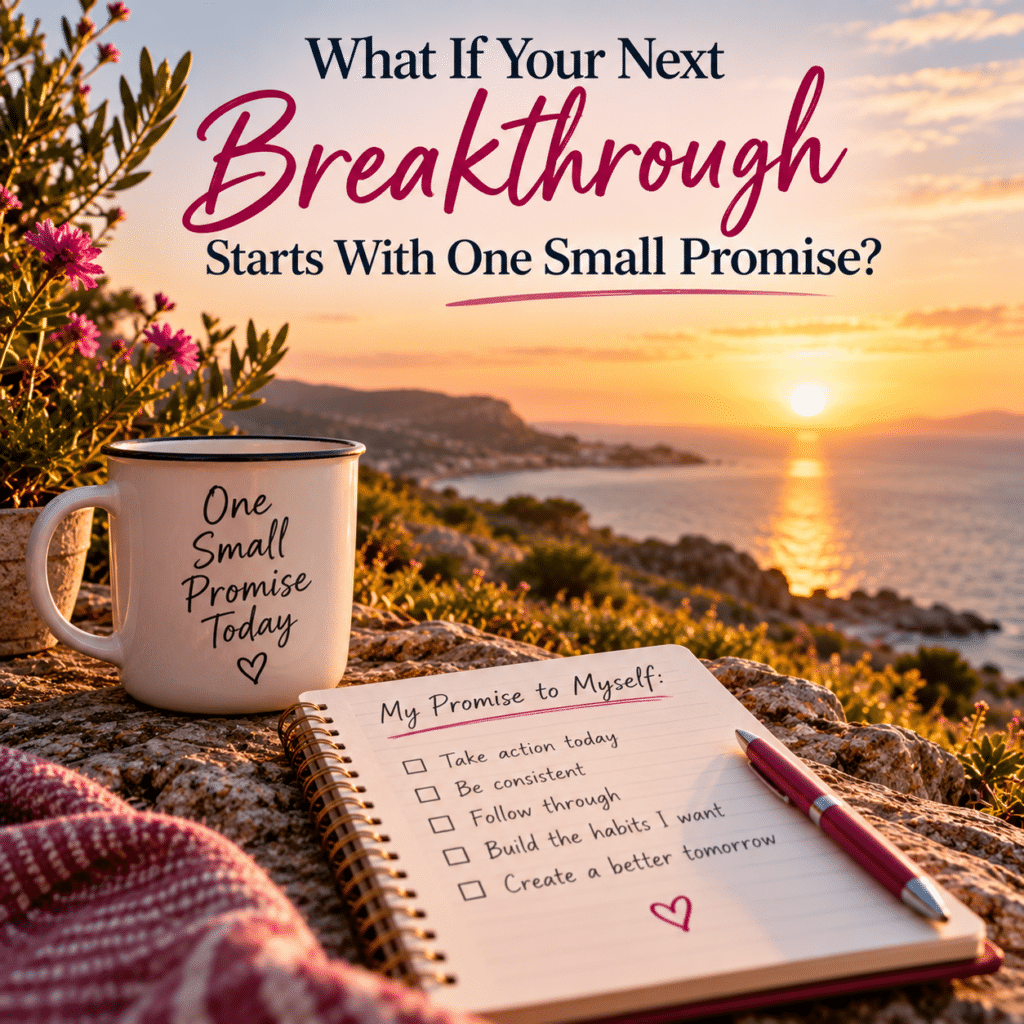
Because every time you follow through on a promise to yourself, you give yourself evidence that you can trust yourself to take action. You begin to see yourself differently.
Instead of being someone who always intends to do things, you become someone who does them. And, instead of repeatedly telling yourself that you’ll start tomorrow, you begin building a pattern of taking action today.
This is how consistency develops. Not necessarily through huge efforts or extraordinary motivation, but through repeated decisions to do what you said you would do.
And the beauty of this approach is that you don’t need to wait until you feel confident, inspired or ready. You can begin with the confidence you have right now, even if that confidence is small. You can begin before the fear disappears. And, you can begin before everything is perfectly organised.
You can begin with one promise.
The Power of Keeping Promises to Yourself
There’s something important about the relationship we have with ourselves.
When we repeatedly set goals and abandon them, make commitments and break them, or tell ourselves we’ll change while continuing to do the same things, we can gradually lose trust in our own ability to follow through. We might not consciously recognise it, but our actions influence the way we see ourselves.
The good news is that we can begin rebuilding that trust through our everyday choices. Start small. Set a commitment you can realistically honour, and follow through.
If you decide to work on a project for fifteen minutes, give it those fifteen minutes. If you promise yourself you’ll complete one important task, make that task a priority.
And if something genuinely prevents you from following through, don’t use it as an excuse to give up altogether. Adjust your plan and begin again.
This isn’t about becoming perfect or demanding more of yourself every single day. It’s about developing a healthier relationship with your own commitments.
It’s also about learning to take responsibility for the things you can influence, without beating yourself up over the things you cannot control.
You don’t need to transform your entire life overnight. You need to begin creating evidence, one action at a time, that you are capable of moving in the direction you want to go.
A Simple Exercise: Turn Your Intention Into Action
Let’s bring this together with a little exercise.
Take a few minutes for yourself and think about one area of your life or business where you feel stuck. It doesn’t have to be the biggest problem you’re facing. In fact, it’s often better to choose something specific and manageable.
Now, answer these four questions honestly:
1. What do I already know I need to do?
Identify the action you’ve been avoiding or postponing. Be specific.
2. What has been stopping me?
Is it fear, uncertainty, perfectionism, distraction, overwhelm or something else? Don’t judge your answer. Simply acknowledge it.
3. What is one small action I can take within the next 24 hours?
Choose something realistic that will move you in the right direction. Make it small enough that you can get started without needing to reorganise your entire life.
4. What promise am I willing to make to myself, and when will I keep it?
Write down your commitment and decide exactly when you’ll take action (what + when). Then do it.
Don’t wait until you feel completely ready. Don’t spend another hour searching for a better approach if the next step is already clear.
Give yourself the opportunity to discover what happens when you stop thinking about taking action and actually take it.
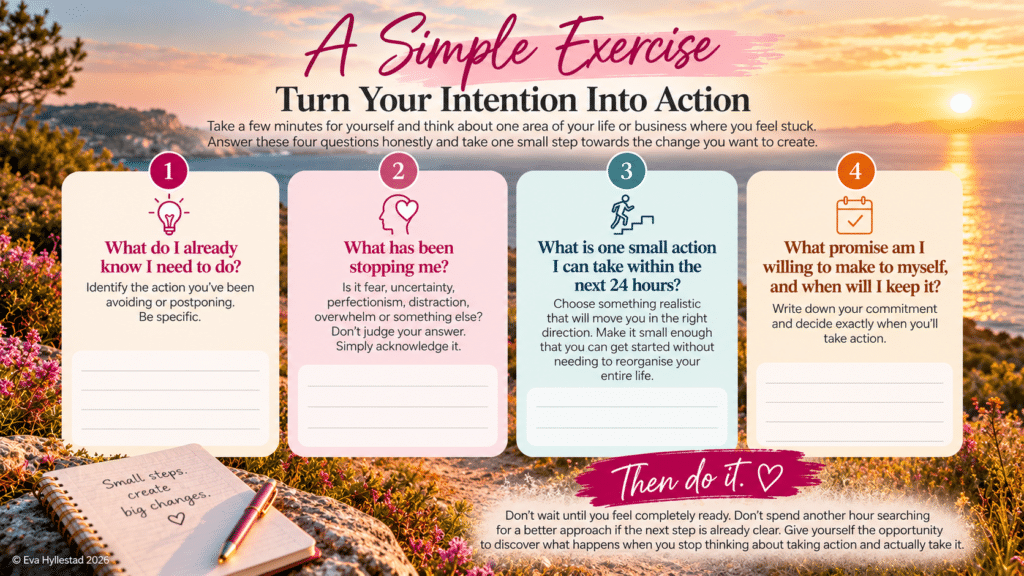
Feel free to download the worksheet so you can turn your intention into action.
If you have problems downloading it, let me know in the comments, or contact me directly on Facebook.
You Don't Need to Have Everything Figured Out
Personal growth is rarely a straight line. Some days, you feel motivated, focused and ready to take on the world. Other days, you question yourself, lose momentum or wonder whether you’re making any progress at all. That’s part of being human.
The goal isn’t to eliminate every obstacle, avoid doubt or become someone who always knows exactly what to do. The goal is to become more aware of your patterns, take responsibility for your choices and learn to move forward even when circumstances aren’t perfect.
You can continue learning without constantly searching for another answer. You can acknowledge your fears without allowing them to make every decision for you. And you can work towards meaningful goals without expecting yourself to accomplish everything at once.
Most importantly, you can stop waiting for the perfect moment to become the person you want to be. That person is shaped by the choices you make today, including the small decisions that might not seem significant at the time.
So, if you know what you need to do but keep putting it off, perhaps it’s time to look at the situation differently.
You might not need another strategy. You might not need to work harder. You might simply need to understand what’s holding you back, take one small step and keep one small promise to yourself.
Because sometimes, the breakthrough you’ve been waiting for begins the moment you decide to stop waiting.
I’d love you to reflect on this: What’s one small promise you can make to yourself today that will move you closer to the life or business you want to create?
Don’t underestimate the power of a small step taken consistently. You never know where it might lead. Share your commitment in the comments below. Putting your intention into words can be a meaningful first step towards turning it into action.
Ready to Turn Inaction Into Action?
Perhaps you recognise yourself in this article. You know what you want to achieve, and you may even know what you need to do, but something keeps getting in the way. You find yourself postponing, overthinking or searching for another solution instead of moving forward.
You don’t have to figure it all out on your own.
Sometimes, talking things through with someone who can offer a fresh perspective helps you recognise what’s holding you back and identify a practical way forward.
If you’re ready to move from inaction to action, I’d love to invite you to book a complimentary call with me.
We’ll explore where you are right now, where you want to go and what might be preventing you from taking the next step. Together, we can look at how to move forward with greater clarity and confidence, one step at a time.
You don’t need to have everything figured out before you begin. You just need to be willing to begin.
Your next breakthrough might start with one small promise — or one conversation.
Join the newsletter
Get new blog posts and updates delivered straight to your inbox. No spam, unsubscribe anytime.

Personal Development Related Posts
DISCLAIMER:
Individual results will vary, and results are NOT guaranteed.


