


How to Identify What’s Really Holding You Back
Have you ever felt as though you were going around in circles? You work harder, try a different approach, read another book, watch another training, or promise yourself that this time things will be different. And yet, a few weeks or months later, you find yourself facing the same problem all over again.
Perhaps you struggle to stay consistent with your goals. Maybe you keep putting off the one thing you know could move your business forward. Or perhaps you started your business dreaming of freedom, flexibility, and more control over your life, only to discover that you seem to be working harder than ever.
If any of this sounds familiar, I want you to consider a question that might change the way you approach your challenges: What if the problem you are trying so hard to solve isn’t actually the real problem?
Sometimes, the biggest obstacle to our progress isn’t a lack of knowledge, effort, or ambition. It’s that we are trying to solve the wrong problem.
How Long Are You Going to Keep Struggling with the Same Problem?
We all have patterns. Some help us move forward, while others keep us stuck in familiar cycles. The challenge is that we don’t always recognise them, especially when we are so busy trying to make things work.

Think about how often you have promised yourself that you would finally get organised, become more disciplined, improve your finances, grow your business, or make time for your own wellbeing.
You start with enthusiasm, make a plan, and perhaps even see some progress. Then life happens, old habits return, and before you know it, you are back where you started.
It is tempting to respond by pushing harder.
You tell yourself you need more discipline, better time management, greater motivation, or another strategy. Sometimes, those things genuinely help. But what happens when you have tried them repeatedly and nothing seems to change?
At some point, it is worth pausing to ask whether you are addressing the cause of the problem or simply reacting to its consequences.
For example, someone who constantly struggles to complete important tasks might assume they have a time-management problem. They download another planning app, create a new schedule, and promise to become more productive.
But what if the real issue is that they are afraid of making the wrong decision? What if they are trying to do too many things at once because they haven’t decided what matters most? Or what if they are so worried about disappointing others that they keep saying yes to requests that leave no room for their own priorities?
A better planner will not necessarily solve any of those problems.
The point isn’t to blame yourself for being stuck. It is to become curious enough to discover what is keeping you there.
You Need to Understand What's Actually Getting in Your Way
One of the most important principles in personal development is learning to distinguish between what you can see on the surface and what is happening underneath.
The visible problem is often the easiest part to identify.
You are not getting enough customers. You keep overspending. You struggle to follow through on your plans. You feel overwhelmed, frustrated, or disappointed with your progress.
But beneath the visible problem, there may be beliefs, habits, fears, assumptions, or circumstances influencing your behaviour.
Consider an entrepreneur who wants to grow their business but struggles to promote their services consistently.
On the surface, the problem might appear to be a lack of marketing skills. Yet they may already know how to create

content, communicate their value, and reach potential customers.
The real obstacle might be a fear of rejection. Perhaps they worry about what other people will think, feel uncomfortable talking about money, or believe that selling means being pushy.
Until they recognise what is happening, they may continue collecting marketing strategies without ever addressing the issue that prevents them from using those strategies.
This is why self-awareness matters so much. You cannot make an effective change if you don’t understand what needs to change in the first place.
It is also important to recognise that not every challenge comes from your mindset. Sometimes, you genuinely need more resources, better information, additional skills, or practical support. The goal is not to assume that every problem is psychological. It is to investigate honestly before deciding on a solution.
Clarity comes from asking better questions, not simply from trying harder.
What If the Problem You're Trying to Solve Isn't the Real Problem?
Let’s take a closer look at a situation many entrepreneurs will recognise.

You started your business because you wanted more freedom. Perhaps you wanted to control your own schedule, spend more time with the people you love, travel, build financial independence, or create something meaningful on your own terms. You imagined a life in which you had greater flexibility and more choices.
Then reality arrived.
You became the strategist, marketer, salesperson, content creator, administrator, customer service department, and everything else your business needed. You spend hours creating content, responding to messages, researching new opportunities, and trying to keep up with everything on your to-do list.
Somewhere along the way, the freedom you were working towards began to feel increasingly distant.
So, what is the problem?
You might assume that you need to become more productive. Perhaps you need to wake up earlier, work longer hours, organise your calendar more efficiently, or learn how to get more done in less time.
But what if productivity isn’t the real issue?
What if the problem is that you have built a business that depends on you doing everything?
What if you are spending too much time on activities that don’t contribute meaningfully to your goals? What if you have not established clear priorities, created repeatable processes, or decided which tasks genuinely require your personal attention?
And what if you have unconsciously adopted the belief that being busy is proof that you are making progress?
These are very different problems, and they require very different solutions.
If your business depends on you being available for every task, working more efficiently might help you cope, but it will not necessarily give you the freedom you wanted in the first place.
You may need to simplify your offers, focus on the activities that produce results, create systems that reduce repetitive work, or reconsider how you structure your working day.
You may even need to redefine what success means to you.
The important question is not simply, “How can I get more done?” It is, “Am I spending my time and energy building the life and business I actually want?”
That question can be uncomfortable. It can also be the beginning of a much better direction.
The Difference Between Being Busy and Making Progress
We live in a world that often celebrates constant activity. Busy calendars, long working hours, endless notifications, and packed to-do lists can create the impression that we are moving forward.
But activity and progress are not the same thing.
You can spend an entire day working on your business without completing a single task that meaningfully advances it. You can read dozens of books about personal development without implementing what you learn. You can spend months researching opportunities while avoiding the decision that would allow you to move forward.
I know how tempting it can be to keep looking for the next idea, the next strategy, or the missing piece of information. Learning is valuable, and there is always more to discover. But at some point, we have to ask ourselves whether we are learning to grow or learning to avoid taking action.
Sometimes, gathering more information feels safer than making a decision. Planning feels safer than being visible. Perfecting an idea feels safer than allowing other people to see it.

Recognising this doesn’t mean you should abandon preparation or stop learning. It means becoming honest about the purpose behind your actions.
Are you doing this because it moves you closer to your goal, or because it helps you avoid something uncomfortable?
That distinction can reveal more than another productivity technique ever will.
Five Questions to Help You Identify What's Really Holding You Back
The next time you find yourself struggling with a recurring problem, resist the urge to immediately search for another solution. Instead, give yourself a little space to investigate.
Here are five questions worth asking.
1. What is the actual problem I am experiencing?
Describe the situation as objectively as possible. Instead of saying, “I’m terrible at business,” try something more specific, such as, “I’m attracting interest, but very few people are becoming paying customers.” A clear description gives you something concrete to investigate.
2. What have I already tried, and what happened?
Look at your previous attempts without judging yourself. Which approaches helped? Which made little difference? Are you repeatedly using the same strategy and expecting a different outcome? Your experiences contain useful information if you are willing to examine them.
3. What might be contributing to this problem?
Consider your habits, assumptions, skills, resources, environment, priorities, and decisions. Are you avoiding a difficult conversation? Trying to do too much? Missing an important skill? Working with unrealistic expectations? Be open to several possibilities rather than immediately settling on the first explanation.
4. What am I avoiding, overlooking, or unwilling to question?
This can be the most revealing question of all. Sometimes, the answer challenges a belief you have held for years. Perhaps you believe you must do everything yourself to maintain quality. Perhaps you think asking for help means you have failed. Perhaps you are holding on to a goal that no longer reflects what you truly want.
You don’t have to accept every uncomfortable thought as the truth. Simply allow yourself to explore it.
5. What is the smallest meaningful action I can take next?
Insight is valuable, but insight without action rarely changes your circumstances. Once you have identified a likely obstacle, decide what you can do to address it. You don’t need to transform your entire life in one afternoon. One honest conversation, one clear boundary, one decision, or one change in your daily routine may be enough to begin shifting the pattern.
Write down your answers. Sometimes, seeing your thoughts on paper makes connections that are difficult to recognise when everything is competing for attention inside your head.
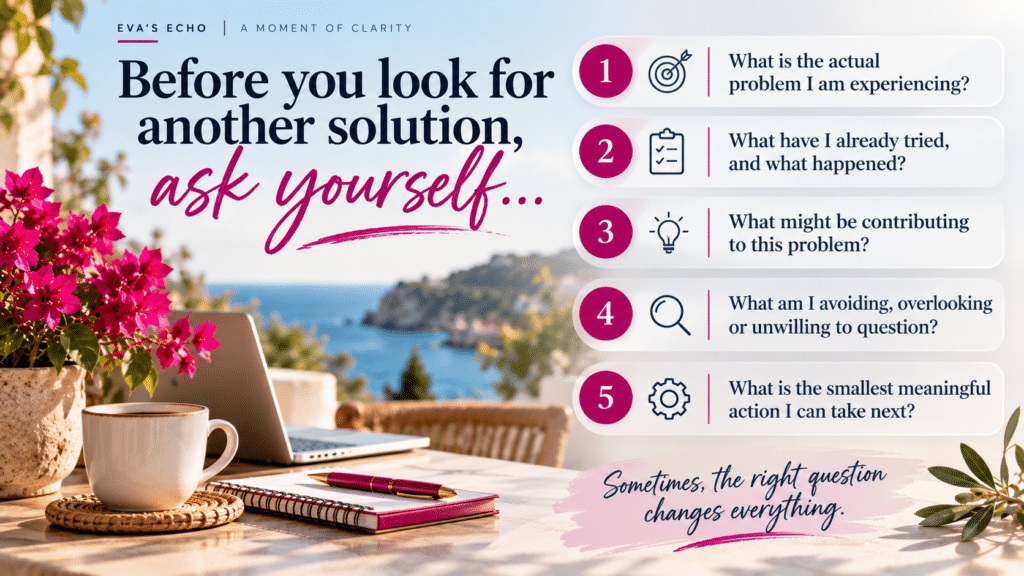
Feel free to download the image, or take a screenshot of it.
Take Responsibility Without Blaming Yourself
There is an important distinction between taking responsibility for your life and blaming yourself for everything that happens in it.
Taking responsibility means recognising where you have influence and choosing to use it. It means being willing to examine your decisions, challenge unhelpful patterns, learn new skills, and take action where action is possible.

Blaming yourself, on the other hand, keeps you trapped in shame.It encourages you to interpret every setback as evidence that you are not good enough, not disciplined enough, or somehow incapable of succeeding.
That is not the mindset I want you to cultivate.
You can acknowledge that something isn’t working without making it a judgement about your worth.
You can recognise a mistake without turning it into your identity.
You can admit that you need to change direction without deciding that your previous efforts were wasted.
Sometimes, the problem is a habit you can change. Sometimes, it is a strategy that needs adjusting. Sometimes, circumstances outside your control have made your original plan unrealistic.
The power lies in being honest about what is happening and then deciding how to respond.
One of the principles I return to in personal development is the idea that while we cannot control everything that happens to us, we can often influence how we respond. That shift in perspective opens the door to learning instead of remaining stuck in frustration.
You don’t need to have all the answers. You need the willingness to look at the situation clearly and take the next constructive step.
Stop Trying to Fix Everything at Once
Once you begin recognising the patterns behind your challenges, you may discover several things that need attention. It can be tempting to overhaul everything immediately.
You decide to change your habits, reorganise your business, improve your finances, exercise daily, read more, and finally get your life in order. The enthusiasm is wonderful, but trying to change too much at once can leave you overwhelmed before you have established a single lasting habit.
Instead, choose the issue that is having the greatest impact on your life or business right now.
If you are an entrepreneur, that might mean clarifying your offer before creating another marketing campaign. If you struggle with consistency, it might mean identifying why you keep abandoning your plans rather than designing a more complicated routine. If you feel overwhelmed, it might mean deciding what you can stop doing instead of adding another productivity system.
Focus on the change that is most likely to make a meaningful difference.
Then give yourself the opportunity to practise it, learn from the results, and adjust where necessary.

Progress is not always dramatic. Often, it comes from small, deliberate decisions repeated consistently over time.
And remember, changing direction is not failure. Sometimes, it is evidence that you have learned enough to make a better decision.
Your Next Breakthrough Might Begin with a Better Question
How long are you going to keep struggling with the same problem?
Not because you should be further ahead by now. Not because you need to work harder to prove something to yourself or anyone else. But because you deserve to stop spending your energy fighting the same battle without understanding why it keeps returning.
You do not need another year of frustration to give yourself permission to look at things differently.
Perhaps you don’t need another strategy. Perhaps you need to question the assumptions behind the one you are already using. Perhaps you don’t need to become more productive. Perhaps you need to decide what is genuinely worth your time. And perhaps the obstacle you have been trying to overcome is only one part of a much bigger picture.

Give yourself permission to pause, reflect, and ask a different question.
What is really happening here? What have I not yet considered? What needs to change for me to move forward?
You might not discover the answer immediately. That is perfectly fine. The purpose is not to find someone or something to blame, but to develop the awareness that allows you to make better choices.
Your next breakthrough may not come from doing more. It may come from finally understanding what deserves your attention.
And that is a powerful place to begin.
A Little Reflection for You
Take five minutes today and think about one challenge that has been following you around for longer than you would like.
Write down what you believe the problem is. Then ask yourself: “What if this isn’t the real problem? What else could be going on?”
Be curious. Be honest. And be willing to consider an answer you may not have thought of before. Sometimes, the first step towards a different result is seeing the situation through a different lens.
If this article has given you something to think about, I’d love to hear from you. What is one recurring challenge you are ready to stop struggling with, and what might you need to look at differently?
Share your thoughts below, and let’s keep learning and growing together.
Join the newsletter
Get new blog posts and updates delivered straight to your inbox. No spam, unsubscribe anytime.

Disclaimer:
Individual results will vary, and results are NOT guaranteed.


