Some of the greatest discoveries don’t happen in museums, universities, or laboratories. They don’t always come from years of research or expensive expeditions. Sometimes they happen while sitting quietly in the shade of a tree. Sometimes they begin with nothing more than a simple question.
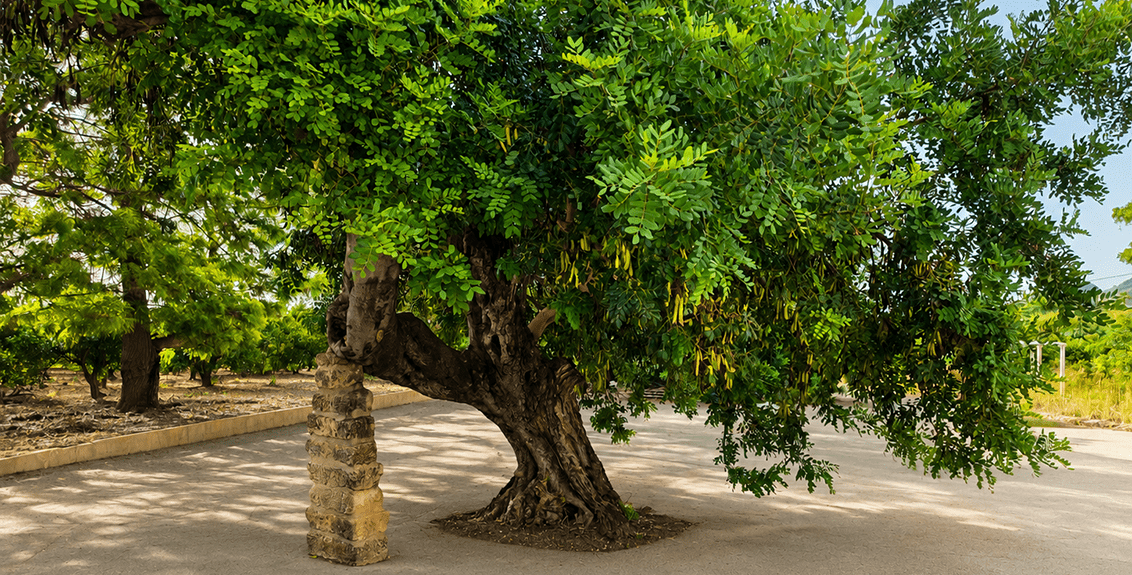
One warm and humid afternoon, I found myself enjoying the peaceful Spanish countryside. The summer sun was beating down, but beneath the wide canopy of an old tree I found welcome relief. The shade was cool, a gentle breeze drifted through the branches, and for a little while the only sounds were birds singing and leaves rustling overhead.
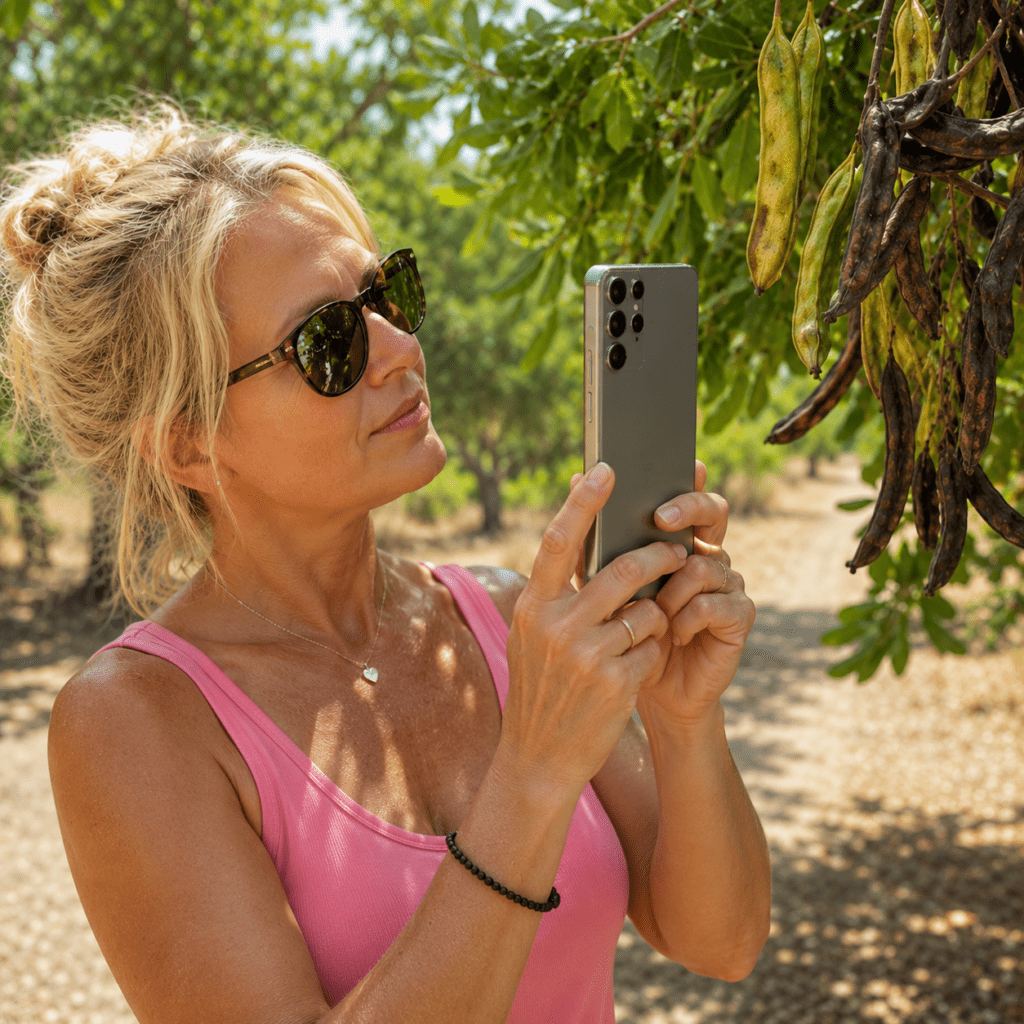
It was one of those moments when life seems to slow down just enough for you to notice things you would normally walk straight past. As I looked up into the branches, something hanging from the tree caught my attention. Long green and dark brown pods swayed gently in the breeze.
I’d seen trees like this many times before. In fact, I’d probably walked past hundreds of them over the years without ever wondering what they were. They had simply become part of the landscape – another familiar sight that blended into the background.
But this time was different.
Curiosity had other plans.
I reached for my phone, took a few photographs of the pods hanging from the branches, and then photographed several that had already fallen to the ground.
Instead of simply admiring them and moving on, I decided to ask AI a question that had suddenly popped into my mind.
“What type of tree is this, and what are those pods hanging from it?”
I expected a straightforward answer – a name, perhaps a sentence or two describing the tree.
What I received instead was a fascinating journey into Mediterranean history, nutrition, agriculture, commerce and even the origins of a word we still use today when talking about diamonds.
Who would have imagined that those ordinary-looking pods contained a story stretching back centuries?
The more I learned, the more intrigued I became. I discovered that these weren’t just seed pods hanging from a tree. They had fed both people and animals, supported farming communities, influenced trade across the Mediterranean, and even played a part in the way precious gemstones were weighed long before modern technology existed.
It reminded me that nature is full of hidden treasures – not only in what it provides, but in the stories it quietly carries from one generation to the next.
That afternoon didn’t just teach me about a tree. It reminded me of something even more valuable. Curiosity has a remarkable way of turning ordinary moments into extraordinary discoveries.
And sometimes, all it takes is asking one simple question.
More Than Just Pods
The tree turned out to be a carob tree, and those strange-looking pods have been valued around the Mediterranean for centuries.
People once called carob the black gold of the Mediterranean.
The sweet pods were used as food for both people and animals. They could be ground into flour, made into syrup, or fed to livestock. Even today, carob is used as a healthy alternative to chocolate because it’s naturally sweet, caffeine-free, rich in fibre, and packed with minerals like calcium and potassium. That’s good news for any chocolate lover who wants healthier alternatives.
But that wasn’t the part that fascinated me the most.
The Tiny Seed That Changed History
Inside every carob pod are several incredibly hard, glossy brown seeds. At first glance, they don’t seem particularly remarkable. In fact, most people would probably throw them away without giving them a second thought.
But these tiny seeds have a fascinating story to tell.
Centuries ago, long before digital scales and precision instruments existed, traders and jewellers faced a challenge.
They needed a reliable way to weigh precious gemstones such as diamonds, rubies, sapphires and emeralds.
Accuracy was everything, but finding small objects that weighed consistently wasn’t easy.
Then someone made an extraordinary observation.
Almost every mature carob seed weighs nearly the same.
Nature had created its own remarkably consistent measuring tool.
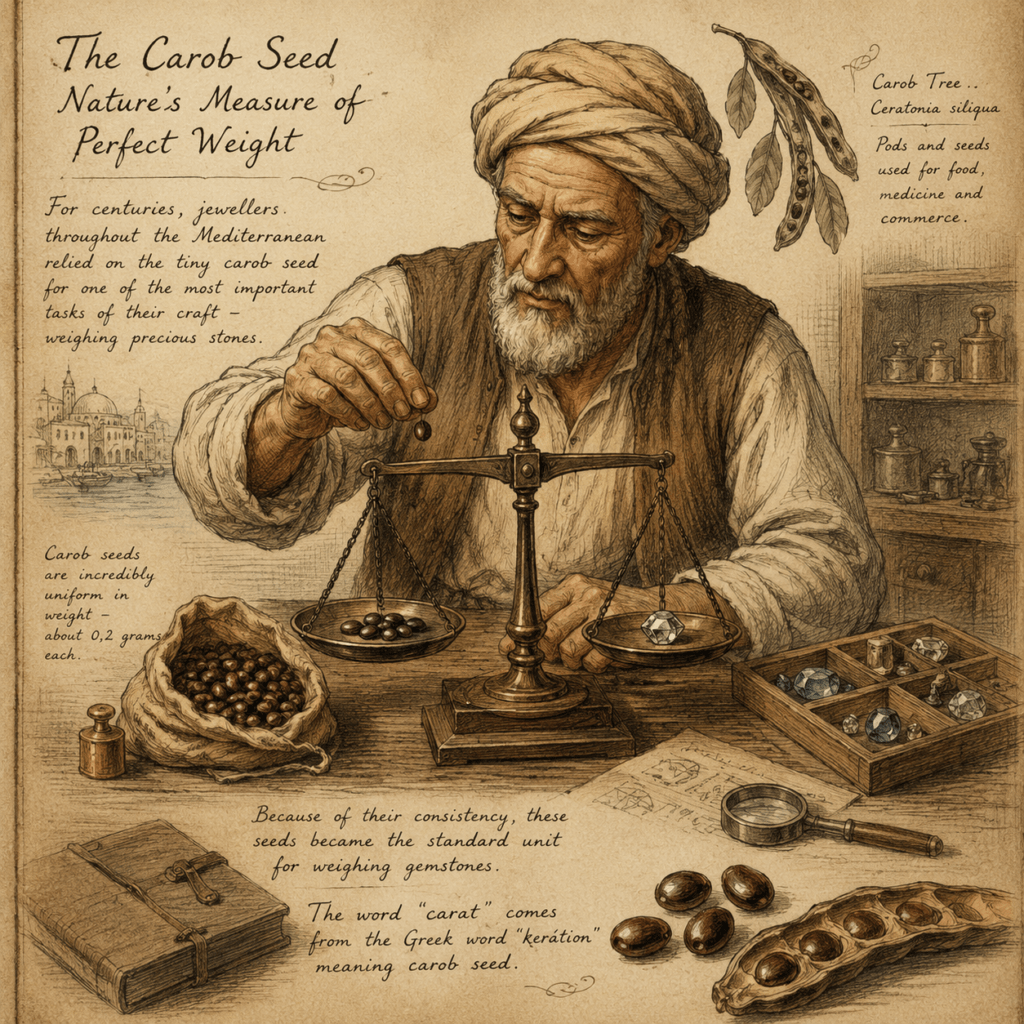
Because of this natural uniformity, jewellers throughout the Mediterranean and the Middle East began using carob seeds as a standard for weighing precious stones. They would carefully place the seeds on one side of an antique balance scale and the gemstone on the other, adding or removing seeds until the scale balanced perfectly.
Over time, these tiny seeds became the benchmark for measuring gems, helping traders conduct fair and trusted transactions across different regions and cultures.
That is where the word carat comes from.
The term is believed to originate from the Greek word keration, meaning “carob seed.” Even today, when you hear someone describe a diamond as one or two carats, you’re hearing a word whose roots stretch back hundreds of years to a humble seed hanging from a Mediterranean tree.
Imagine that for a moment.
A tiny seed, quietly growing inside an ordinary-looking pod, helped shape one of the world’s most recognised systems of measurement. It became part of the language of jewellery, commerce and craftsmanship – a legacy that continues to this day.
How many people walk past these trees every day without ever knowing that such an important piece of history is hanging quietly above their heads?
I know I did.
Until one simple question led me to discover that one of nature’s smallest gifts had left one of history’s biggest impressions.
What Else Are We Walking Past?
That simple discovery made me think.
How many plants, flowers, berries, trees, herbs do we pass every day without ever wondering what they are?
Nature has been teaching lessons long before there were classrooms.
Many plants have incredible nutritional value. Others became medicines.
Some shaped entire cultures. Others fed families through difficult times.
And many have fascinating stories hidden behind them.
Sometimes all it takes is asking one question.
Curiosity Is One of Our Greatest Superpowers
Children ask hundreds of questions. Adults often stop asking. Maybe because we’re busy. Maybe because we think we should already know.
Yet curiosity keeps our minds alive. It helps us learn. It opens new conversations. It connects us with history.
It reminds us that the world is still full of things we’ve never noticed before.
One simple question about a tree gave me enough inspiration to write this article.
Who knows where your next question could lead?
Your Turn
The next time you’re out walking…
Take a closer look. Notice a tree you’ve never really paid attention to. Pick up an unusual leaf. Photograph a flower. Ask someone what that berry is.
You can even ask AI as I did.
Then follow the trail wherever your curiosity takes you. You might discover something that surprises you. Or perhaps you’ll uncover a story that’s been waiting hundreds of years to be told.
I’d Love to Hear From You
Have you ever discovered something fascinating about a plant, tree, flower, fruit or berry that completely surprised you?
Or perhaps you have memories of collecting carob pods, chestnuts, berries, mushrooms, herbs or something else growing up?
Share your story in the comments below. Because sometimes the most ordinary things have the most extraordinary stories.
And I’d love to hear yours.
Join the newsletter
Get new blog posts and updates delivered straight to your inbox. No spam, unsubscribe anytime.

Disclaimer:
Individual results will vary, and results are NOT guaranteed.