

What Asha Has Taught Me About Looking Beyond Appearances
Until fairly recently, I had no idea that October was Black Cat Awareness Month.
Of course, I knew the stereotypes. Black cats and witches. Black cats and Halloween. Black cats supposedly bringing bad luck if they happen to cross your path. But I had never really stopped to think about where those ideas came from, or that there was actually a month dedicated to challenging them and celebrating black cats.
Then Asha came along.
My little black kitten from Calpe Cat Shelter – Live Love Miau has given me a very personal reason to pay attention this year. And, as anyone who has ever shared their home with a kitten will know, living with one is a far more entertaining education than anything you can read in a book.
A little history behind Black Cat Awareness Month
Black cats have been surrounded by superstition for centuries. In parts of Europe, they became associated with witchcraft and the supernatural, and eventually with bad luck. Their connection with Halloween has only strengthened that image.
Yet black cats have not been considered unlucky everywhere. In some cultures, they have been associated with good fortune, prosperity and positive things.
So whether a black cat brings you good luck or bad luck seems to depend rather more on the story you have been told than on the cat itself.
Personally, I’m going with lucky. Because Asha has certainly brought a lot of joy into my life.
Awareness campaigns such as Black Cat Awareness Month aim to challenge these old perceptions and encourage people to see the individual cat rather than making assumptions based on appearance. Cats Protection’s National Black Cat Day, held on 27 October, was launched in 2011 after the organisation found that black and black-and-white cats in its care were taking longer to find homes than cats of other colours.
And that raises an interesting question: how much can appearance influence the way we see an animal before we’ve even got to know them?
Meet Asha
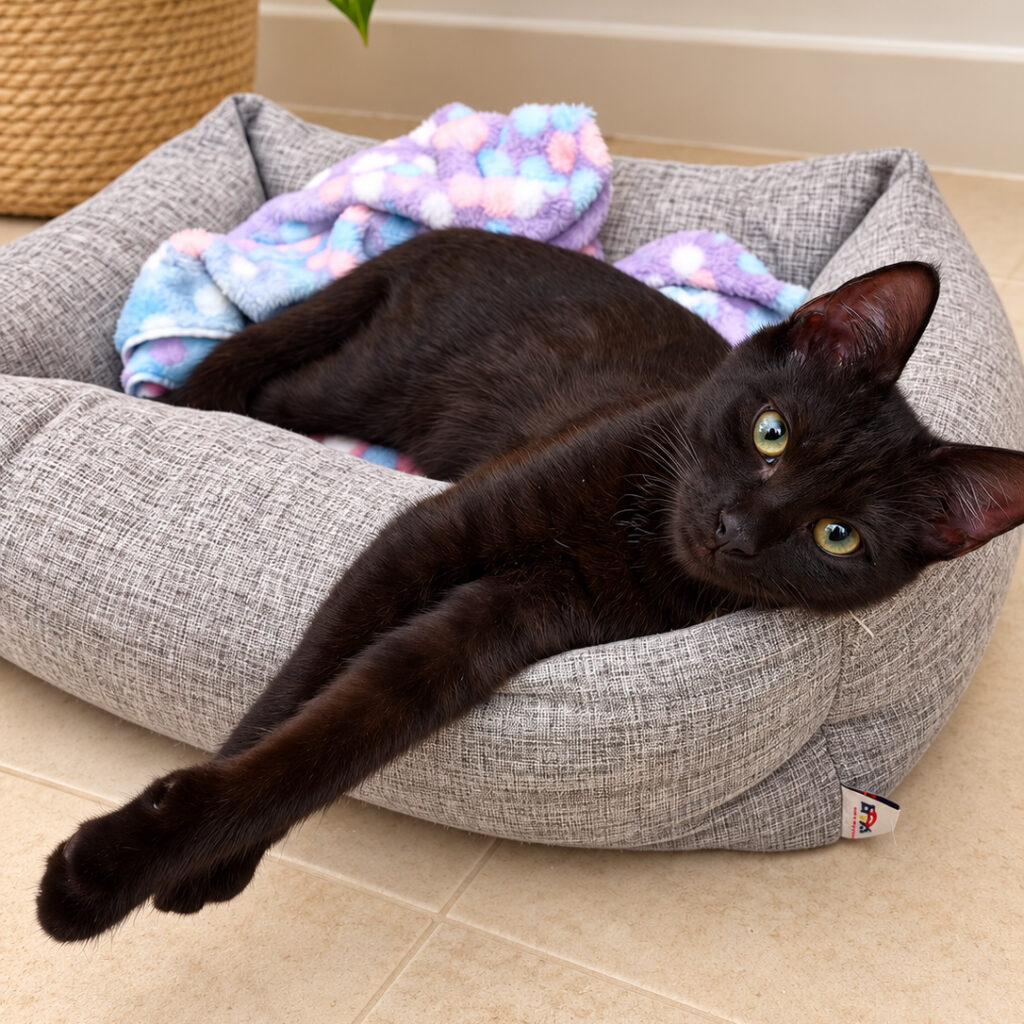
Asha is almost entirely black, apart from two tiny white spots – one between his back legs and another between his front legs. They are so small that you could easily miss them, but of course I know exactly where they are because, once you’re a kitten mama, you notice everything.
His coat can look completely black in some light, while sunlight reveals beautiful chocolate and brown tones. And then there are his eyes, which can appear green or golden depending on the light.
But none of that really tells you who Asha is. For that, you have to spend some time with him.
Asha is an explorer. Everything needs investigating.
A new object, a box, a cupboard, a strange noise – nothing escapes his curiosity.
I can almost imagine the questions running through his head:
What’s that?
Can I climb it?
What’s behind it?
Can I fit in there?
Can I eat this?
That last one comes up rather often.
He is also incredibly vocal, although I’m still learning his language. He has so many different sounds and ways of communicating that I’m not always sure what he’s trying to tell me. Some messages, however, are very clear: Get up, it’s 6 am and I’m hungry. Playtime. I’m not sure about this. And, my favourite, Let’s go.
When Asha says, Let’s go, he means it. He shoots off as if we’re about to compete in a sprint, leaving me to catch up.
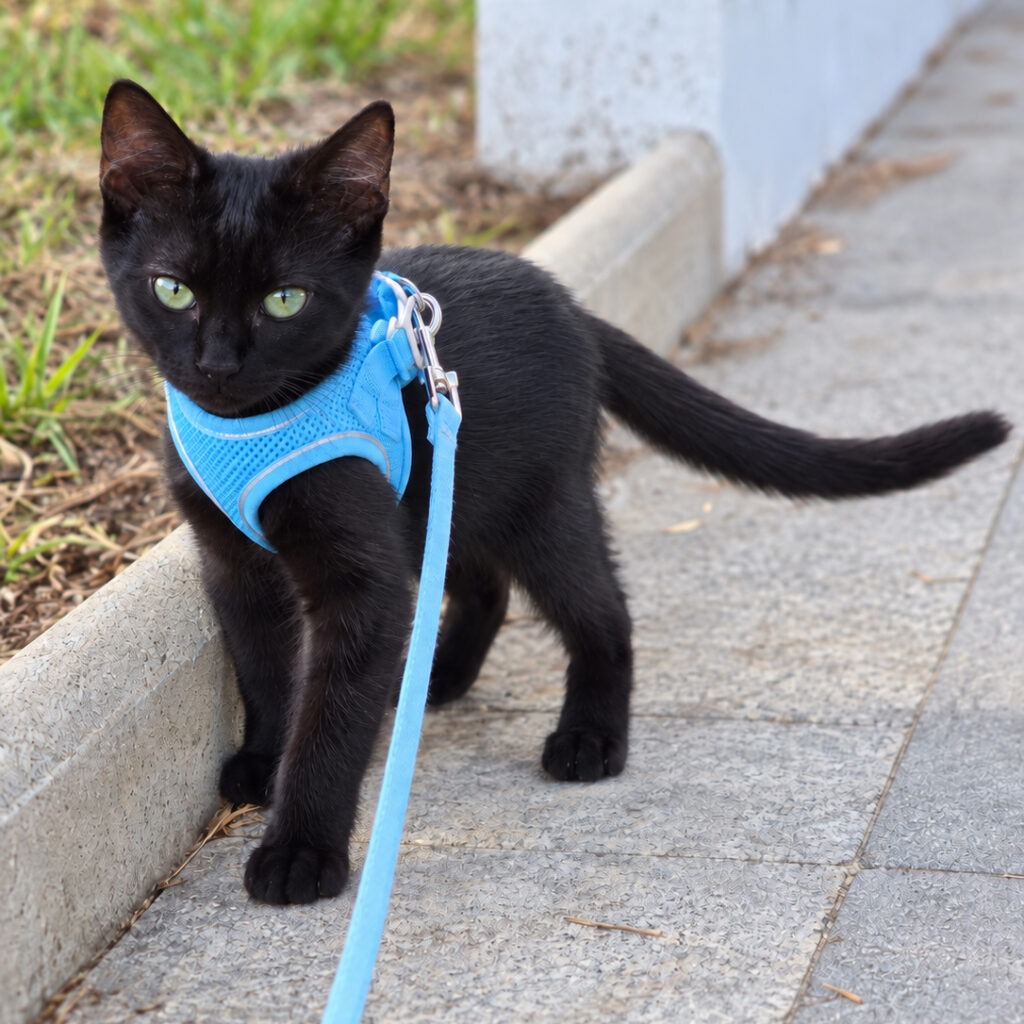
His relationship with his leash is equally entertaining. Some days he is desperate to get out and explore, while on other days he simply lies down and refuses to move. Apparently, walking is something he is happy to do when it suits him.
He’s a cat. I suppose I should have expected that.
The food inspector
Then there is food. Asha eats as though every meal could be his last. But having his own food isn’t necessarily enough.
If I’m eating at the same time, my food must be investigated. After all, perhaps what I have is better than what he has just been served.
And if he’s asleep when I start eating? Somehow, he knows. His eyes open, his ears go up and suddenly he’s beside me, ready to investigate.
I can practically hear the question: Can I eat this? It doesn’t matter that he has just eaten. It doesn’t matter that whatever I’m eating may not even be suitable for him.
It needs investigating. Immediately.
This is one of the many things that make living with a kitten so entertaining. They manage to turn ordinary moments into little adventures.
The cuddles make up for the chaos
For all his curiosity and mischief, Asha can also be incredibly affectionate.
When he curls up on my lap and starts rubbing his head against my lower arms or my fingers, I melt.
Sometimes he pushes his head up underneath my chin, looking for even more closeness.
Those quiet moments are probably my favourites.
There is something very special about an animal choosing to trust you. They don’t care what you’ve achieved, what you’re worrying about or what you were supposed to be doing.
They simply know that they feel safe with you.
Of course, Asha also has a very particular way of reminding me when he thinks he isn’t getting enough attention.

If I ignore him for too long, he may resort to a little bite or a strategically placed claw. He knows it’s not acceptable, and I know he knows it isn’t acceptable, but apparently in his mind the situation could have been avoided entirely if I had simply paid attention to him earlier.
And then come those eyes. Those very apologetic eyes that seem to say, “That wouldn’t have happened if you had given me some attention in the first place.”
It’s difficult to stay annoyed for long.
The reality of kitten life
Of course, kitten life isn’t all cuddles and cute photographs.
There is the early-morning wake-up call. There is the endless demand for playtime. There is the food inspection. There are the occasional claws and teeth. And, naturally, there is the litter tray.
Asha eats enthusiastically, so his litter tray requires equally enthusiastic attention from me. Let’s just say that being a kitten mama isn’t always glamorous.
But that’s the reality of sharing your life with an animal. You don’t just get the beautiful moments. You get the responsibility that comes with them too. And perhaps that’s an important part of responsible adoption that doesn’t always make it into the cute photographs.
A kitten isn’t an accessory or a decoration. A cat is a living being with needs, habits, personality, preferences and a lifetime of care ahead of them.

Look beyond the colour
One of the things I found particularly interesting while researching this subject was a Cats Protection survey which found that black cats were perceived by some people as less playful, friendly, vocal and attention-seeking than cats of other colours.
That made me smile. Because anyone who has met Asha would probably have some thoughts about the “less vocal” and “less attention-seeking” part.
But that’s exactly the point. Asha is Asha. His colour doesn’t tell you that he is curious, affectionate, vocal, adventurous, demanding, funny or occasionally rather cheeky. You only discover those things when you get to know him.
And the same is true of every cat.
The shy one may become your greatest cuddle companion once they learn to trust you. The quiet one may turn out to have the funniest personality. The older cat may be exactly the calm companion you’ve been looking for. The kitten who didn’t immediately catch your eye may become the one who completely captures your heart.
That’s why I think the message behind Black Cat Awareness Month is bigger than black cats.
Look beyond appearances. Take the time to connect with the individual.
Adoption is about connection, not colour
If you are thinking about adding a cat or kitten to your family, I hope you’ll consider adoption and, when you visit a shelter, give yourself permission to look beyond the obvious.
Don’t choose solely because a particular cat has beautiful markings. Don’t automatically overlook the black cat. Don’t assume that the quiet cat won’t be affectionate or that the older cat won’t bring joy.
Instead, spend some time with them.
Ask about their personality. Find out what they enjoy, what makes them comfortable, what their needs are and what kind of home would suit them best.
Because the right connection may not be the cat you noticed first. It may be the one who quietly comes over and sits beside you. The one who looks at you with those trusting eyes. The one who reaches out a paw. The one who makes you laugh.
Or the little black kitten who looks at you as if you’re clearly supposed to know what he is trying to say.
If you’re ready for the responsibility and commitment that comes with sharing your life with a cat, please consider adopting from a shelter or rescue organisation rather than simply choosing based on looks.
There are so many wonderful cats waiting for someone to see them for who they are. And you might just find your Asha.
And yes, there is a handbook for that...
My experience with Asha has also reminded me just how much there is to learn when you bring a kitten into your life.
The adorable photographs are one thing. Understanding their behaviour, helping them settle, creating a safe environment, knowing what they need and navigating all those little kitten moments is another.
That’s one of the reasons I created The Happy Kitten Handbook – to help kitten lovers feel more prepared for the reality of welcoming a kitten into their home.
I’ll be sharing more about it here because, while Asha has taught me an enormous amount through experience, I also know how useful it can be to have practical guidance when you’re navigating those first weeks and months.
And as for my little black cat...
Asha doesn’t know that October is Black Cat Awareness Month. He doesn’t know about centuries of superstition or the history behind National Black Cat Day. He certainly doesn’t care about statistics.
He just knows that there is a world to explore, food to investigate, toys to chase, walks to go on when he feels like it, cuddles to demand, a litter tray that apparently needs constant attention and a human who should probably be available for playtime whenever he decides the moment is right.
And honestly, I think he’s got the right idea. I didn’t set out to become an expert on black cats. I simply became a kitten mama to one.
And somewhere between the early wake-up calls, the food inspections, the mysterious conversations, the leash adventures, the cuddles, the claws, the litter tray and those incredibly expressive eyes, I’ve learned something rather simple.
Don’t judge a cat by its colour. Get to know the cat.
Because behind every coat – black, white, ginger, tabby, tortoiseshell or anything in between – there is an individual waiting to be discovered.
This October, I’m celebrating black cats.
But more than that, I’m celebrating the connection between humans and animals and the wonderful, sometimes chaotic, often hilarious and incredibly rewarding experience of giving a cat a chance to become part of your life.
And yes, I consider myself very lucky to have Asha. Even at 6 am. Because it’s a wakeup call for another day of joy, connection and life as a black kitten mama.


